


California right-of-way rules decide who proceeds when paths meet. First arrival generally has priority at an intersection, simultaneous arrivals yield to the right, and turning drivers must protect pedestrians and conflicting traffic. Always leave room to avoid a collision when someone else makes a mistake.
Last verified: November 3, 2026
Who goes first at a California four-way stop?
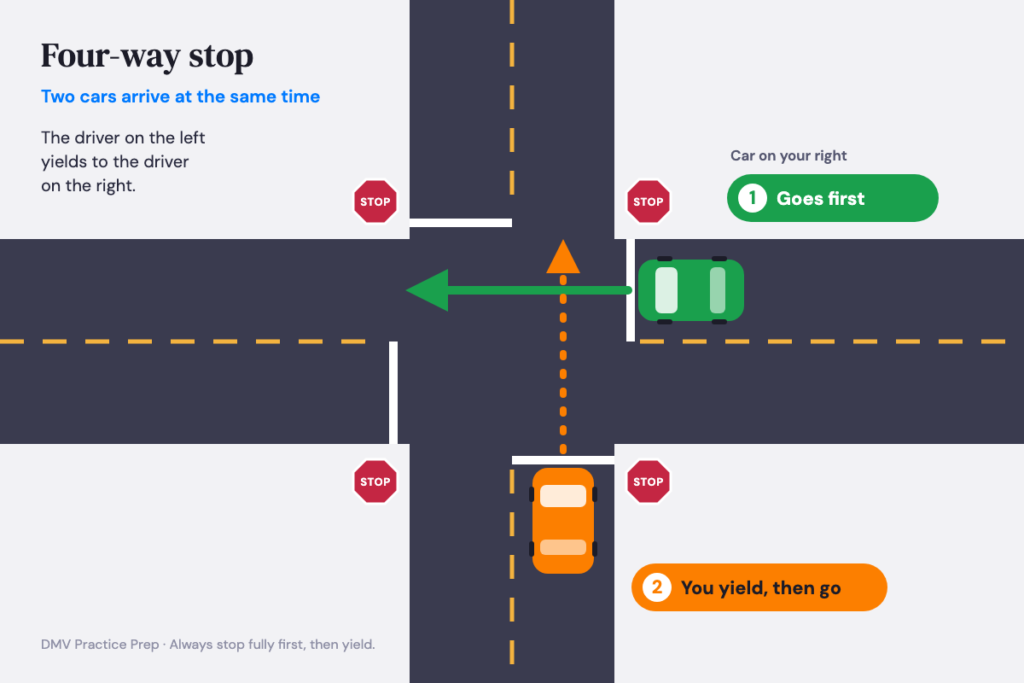
The vehicle that arrives first has priority after stopping; when arrivals are simultaneous, yield to the vehicle, pedestrian, or bicyclist on your right. The California intersection rules apply this order at an all-way stop. A complete stop comes before the decision to proceed.
Check for people crossing and traffic already in the intersection. Priority is not an instruction to accelerate into a conflict. If another driver proceeds out of turn, wait rather than trying to enforce the rule with your vehicle. In a diagram, identify your position relative to the other vehicle instead of relying on the words “left” and “right” from the other driver’s viewpoint.
Who has priority at an uncontrolled T intersection?
Traffic on the through road has priority over traffic entering from the ending road when no STOP or YIELD signs control the T intersection. At other uncontrolled intersections, first arrival and the simultaneous-arrival right-side rule apply.
Look left, right, and ahead before entering. Hedges, parked vans, or buildings can limit the view, so move only as far as you can safely observe. A blind-intersection speed rule does not assign priority; it controls the approach speed. The road user entering must still yield to the traffic that has the right-of-way.
When must a left-turning driver yield?
A left-turning driver yields to pedestrians and approaching traffic close enough to be dangerous. California’s handbook also directs right-turning drivers to check for pedestrians, motorcycles, and bicycles beside them.
Keep your wheels straight while waiting to turn left so a rear impact is less likely to push you into oncoming traffic. Choose a gap large enough to complete the turn without making another road user brake or swerve. A green signal alone does not clear an unprotected left turn. Watch the entire crossing path, including the far-side crosswalk.
What are the California rules for pedestrians?
Drivers yield to pedestrians in marked and unmarked crosswalks. The handbook says to use caution, reduce speed, or stop so a pedestrian crossing the road can finish safely. A painted crossing is not the only place where the pedestrian rule matters.
Do not pass a vehicle stopped at a crosswalk; it may hide a person you cannot see. People using a white cane or guide dog need particular care. Do not honk to tell a blind pedestrian to hurry, and do not stop in the crosswalk. Your vehicle should leave a usable path instead of forcing the person into moving traffic.
Who goes first in a roundabout or near an emergency vehicle?
Traffic already inside a roundabout has priority. Slow, yield, enter toward the right when there is a safe gap, and travel counterclockwise. Follow destination signs and lane markings, and continue around if you miss your exit rather than making a sudden stop.
For an approaching emergency vehicle using a siren and red lights, move to the right edge and stop when safe, following the handbook’s emergency-vehicle guidance. If you are in an intersection, clear it before pulling over. A stopped emergency or road-work vehicle creates a different move-over/slow-down situation; identify whether the vehicle is approaching or stationary before choosing your response.
Can you decide who yields in these questions?
California gives priority to pedestrians using white canes or guide dogs, requires left-turn yielding, and calls for slowing before a roundabout. Apply those rules to these questions.
1. When approaching a person who is crossing the street while using a white cane or guide dog, you should:
- A. Stop until the person is well away from your path of travel.
- B. Honk your horn as you proceed past them.
- C. Carefully drive around them.
Show answer
A. Stop until the person is well away from your path of travel. Stop and give the pedestrian enough time and space to clear your path. Avoid rushing them with a horn.
2. When turning left at an intersection:
- A. You should always yield to oncoming traffic and pedestrians.
- B. Oncoming traffic and pedestrians should yield to you.
- C. You should never yield to oncoming traffic and pedestrians.
Show answer
A. You should always yield to oncoming traffic and pedestrians. Wait for oncoming traffic and crossing pedestrians before starting the left turn.
3. When approaching a roundabout, you should always:
- A. Increase your speed.
- B. Decrease your speed.
- C. Maintain your speed.
Show answer
B. Decrease your speed. Slow before entering, then yield to traffic already circulating and select a safe gap.
Ready to practice California car knowledge? Start a free test and review the explanations for the questions you miss.
Key takeaways
- Stop fully before applying all-way-stop priority.
- Protect marked and unmarked crosswalks and yield on left turns.
- Yield to traffic already in a roundabout and follow emergency-vehicle instructions.
Continue your California preparation: California DMV Written Test 2026: Questions, Passing Score & What to Expect; California Road Signs Test: Signs You Must Know; California Speed Limits Explained.
Explore the California car study guides.
Related guides

How to Get a Driver’s License in California: Step-by-Step
First-time California drivers start with an instruction permit, pass knowledge and vision tests, and then take a behind-the-wheel test.
Common California Road Test Mistakes (and How to Avoid Them)
California’s driving test evaluates how safely you use the car in traffic, not just whether you can steer through a parking maneuver.

California Speed Limits Explained
California’s Basic Speed Law prohibits driving faster than is safe for current conditions.


