Virginia right of way rules require a driver on the left to yield to a driver on the right when both reach a 4-way stop together. The Virginia Department of Motor Vehicles (DMV) explains this tie-breaker in the Virginia Driver’s Manual. Earlier arrivals, pedestrians, emergency vehicles and traffic already inside a roundabout create different yielding duties.
Last verified: November 6, 2026
Key takeaways
Virginia DMV’s yielding guidance asks who is already there, who arrived first and which control applies.
- Virginia’s 4-way stops require every approach to stop before proceeding.
- Virginia drivers arriving together at a 4-way stop yield to the vehicle on their right.
- Virginia’s 2-part knowledge exam includes sign recognition and general rules such as yielding, according to DMV.
What happens when two cars stop together?
Virginia DMV directs the left-hand driver to yield to the right-hand driver when vehicles reach an all-way stop simultaneously; when arrivals differ, the earlier vehicle proceeds first, under the manual’s stop-sign and yielding sections. Virginia drivers must still wait for pedestrians and vehicles already occupying the intersection.
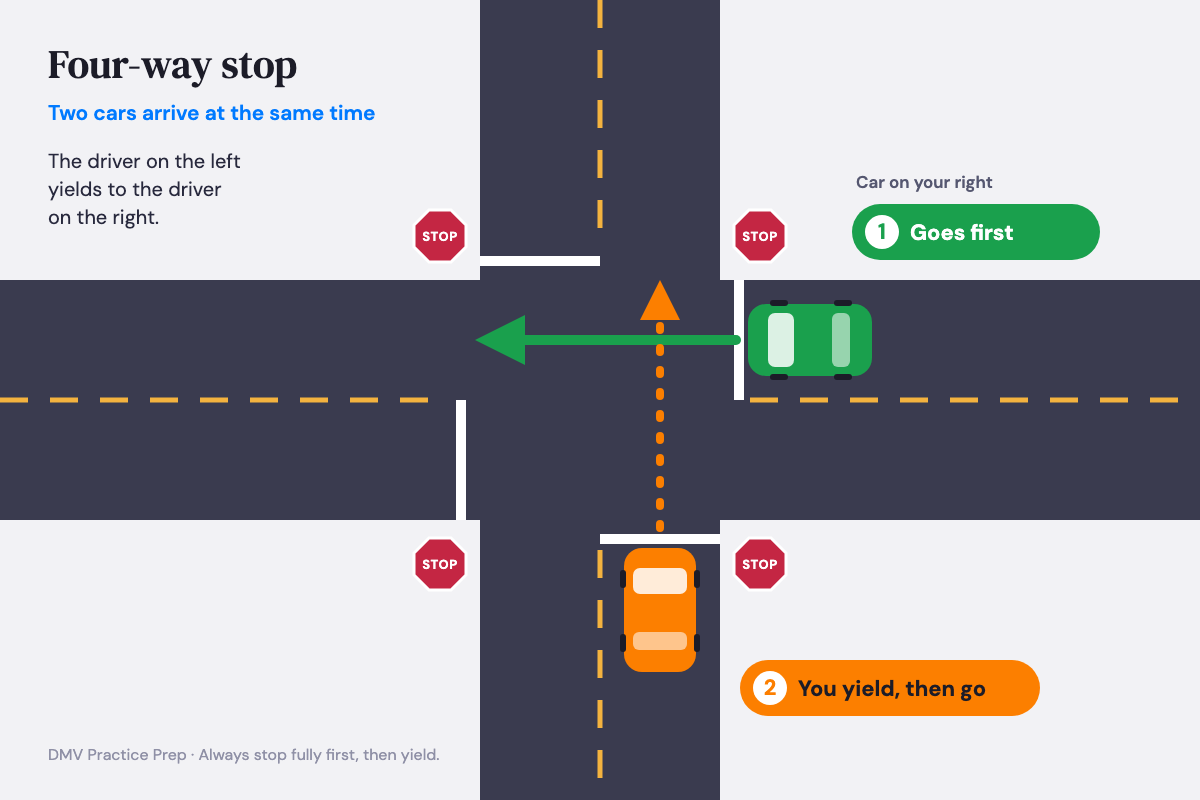
Suppose you stop beside a library while a delivery van reaches the stop on your right at the same moment. Let the van go first. If the van rolls into your path unexpectedly, stay stopped rather than trying to prove your turn. Yielding avoids a conflict; it is not a contest over who can accelerate fastest.
How should Virginia drivers handle dark signals and private exits?
Virginia DMV requires a stop at a traffic signal displaying no lights because of an outage or malfunction, with movement following yielding rules unless an officer or portable control directs otherwise, according to the traffic-signal chapter. Virginia drivers leaving a private road or driveway must stop and yield to roadway traffic and pedestrians.
| Approach | Driver’s decision |
|---|---|
| Signal completely dark | Stop, then use the applicable arrival and yielding rules |
| Parking-lot driveway | Stop before entering; yield to people and roadway traffic |
| Interstate entrance ramp | Yield to traffic already traveling on the highway |
| Left turn without a protected arrow | Yield to opposing traffic and pedestrians |
A wave from one driver does not clear another lane. At a shopping-center exit, check beyond the driver who stopped for you: an approaching bicyclist or a vehicle in the next lane may still cross your path.
Who goes first at a roundabout or crosswalk?
Virginia DMV requires entering roundabout traffic to yield to pedestrians, bicyclists and vehicles already circulating, under its roundabout guidance. Virginia motorists should select a lane using the approach signs, reduce speed and wait for a safe opening. A gap in circulating vehicles does not cancel a person’s crossing priority.
At ordinary intersections, watch the crosswalk while preparing a turn, including a turn permitted on red. A pedestrian’s movement can continue after your light changes. For a person using a white cane or guide dog, the handbook calls for a complete stop; do not merely edge around the person.
What is the response to an approaching ambulance?
Virginia DMV directs drivers to pull safely to the right edge and stop for an emergency vehicle approaching from behind with a siren, flashing lights or both, in its flashing-lights guidance. Virginia also requires stopping for an emergency vehicle approaching opposite on an undivided highway. The handbook notes an exception to these approaching-vehicle requirements in highway work zones.
Do not confuse that moving-emergency response with the rules for a stopped roadside emergency vehicle. For a stationary emergency vehicle or tow truck with flashing lights, change away from the adjacent lane when safely possible; otherwise reduce speed and pass cautiously. Avoid an abrupt lane change into another vehicle.
Does a yield sign always require a complete stop?
Virginia DMV’s yield-sign instruction is to slow down and be ready to stop when needed to let conflicting traffic and pedestrians proceed, according to its sign chapter. Virginia drivers should judge the available space instead of assuming a yield sign always means either an automatic stop or uninterrupted movement.
A red and white triangular sign at an intersection means:
- A. Slow down if an emergency vehicle is approaching.
- B. Look both ways as you cross the intersection.
- C. Always come to a full stop at the intersection.
- D. Slow down and be prepared to stop if necessary.
Show answer
D. A yield sign requires you to let conflicting road users go first. Stop if a safe opening is unavailable.
Continue with Virginia sign controls and safe-speed choices through the Virginia car hub.
Frequently asked questions
Virginia yielding duties continue even when another road user makes an unexpected move.
May I cut between vehicles in a funeral procession?
No. Virginia DMV instructs motorists to yield to funeral processions and not join, cut through or interfere with them.
Can I pass a vehicle stopped at a crosswalk?
Virginia’s manual prohibits passing at a crosswalk. A stopped vehicle may hide someone crossing immediately ahead of it.
Should I insist on my turn if another driver enters?
No. Virginia drivers must avoid a collision even when another motorist fails to yield. Wait for a clear path rather than forcing the conflict.
Related guides

Virginia Permit Test Cheat Sheet: Key Numbers to Memorize
Virginia permit numbers explained with their conditions: posted and default speeds, dry-road following gaps, parking clearances and BAC rules.

Failed the Virginia Permit Test? Retake Rules & Waiting Period
Virginia permit retakes depend on age: a full 15-day teen wait, once-daily adult testing and required training after a third failure.

Common Virginia Road Test Mistakes (and How to Avoid Them)
Correct Virginia road-test preparation mistakes with DMV's observation categories, from paperwork and blind spots to smooth turns and safe parking.