Oregon right-of-way rules require drivers to protect pedestrians, yield when entering conflicting traffic, and make room for emergency vehicles. At a signal-controlled turn, the Oregon Driver and Motor Vehicle Services (DMV) manual requires a crossing pedestrian to be at least 6 feet from the lane you are turning into before you begin the turn. Other crossing situations have different clearance rules.
Last verified: November 8, 2026
When must an Oregon driver remain stopped for a pedestrian?
Oregon requires stopping for pedestrians at marked and unmarked crosswalks when the person is in your travel lane, an adjacent lane including a bike lane, or the lane you are turning into, according to the DMV pedestrian instructions. A person can be crossing when a cane, wheelchair, or other extension enters the roadway. Do not wait until the person’s body is directly in front of the car.
At a turn controlled by a traffic signal, the pedestrian must be at least 6 feet from the intended lane before the turn begins. Without a traffic signal, the pedestrian must be past your intended lane and the next lane, under the Oregon DMV crossing rules. Avoid collapsing these conditions into “go as soon as the person leaves my lane.”
How should Oregon drivers handle a four-way stop?
At Oregon intersections with stop signs in all 4 directions, the DMV manual describes letting the first driver who stops proceed first as common courtesy; when in doubt, yield to the driver on the right. The Oregon intersection guidance also warns against assuming others will yield. Complete the stop and assess the other vehicles before entering.
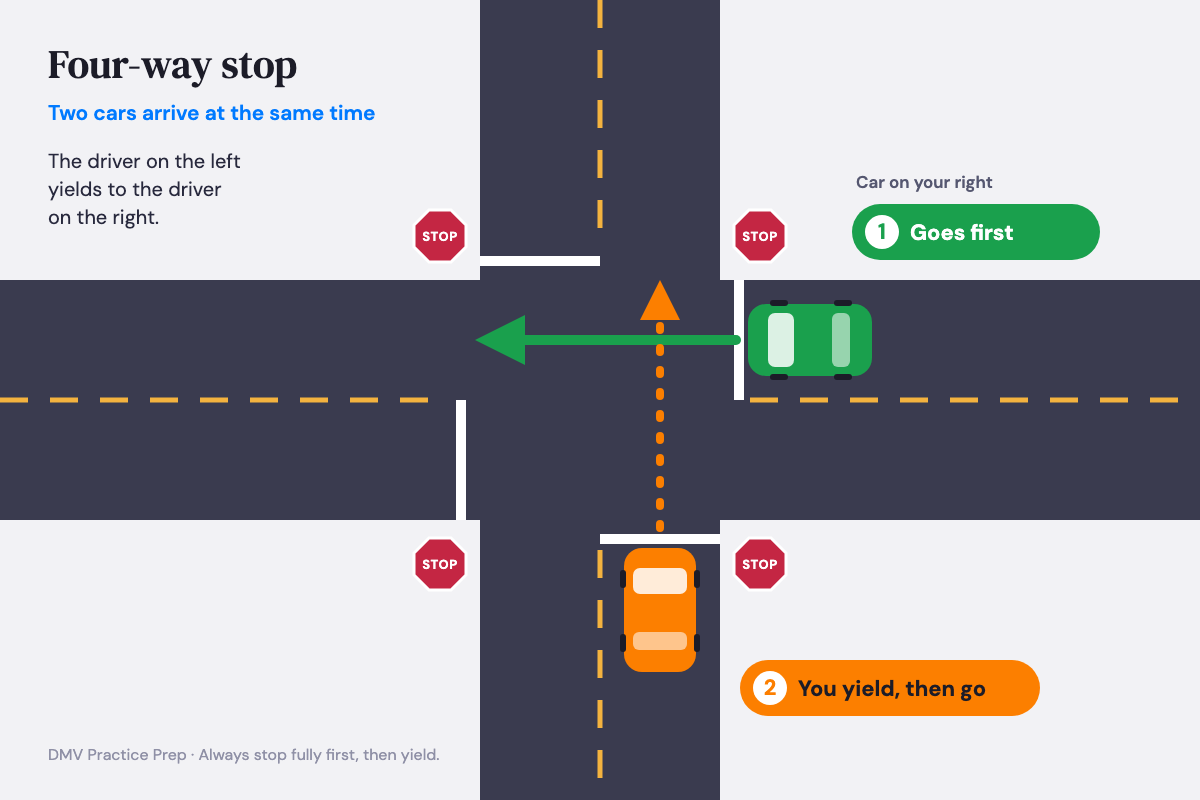
If another driver starts moving out of turn, do not use the rule as a reason to force entry. Wait for a safe path. At an intersection without signs or signals, Oregon’s manual instead instructs yielding to a vehicle already in the intersection or approaching from your right. At an uncontrolled T intersection, the driver on the ending road yields to traffic on the through road.
Who has priority when entering an Oregon roundabout?
Oregon roundabout entrants must yield to traffic inside and exiting the roundabout, according to the DMV roundabout instructions. Slow before entry, watch for crossing pedestrians, and wait for a usable gap. Choose the entry lane using the posted information rather than correcting your route with an abrupt maneuver inside the circle.
Traffic circulates counterclockwise around the center island. Give a person riding a bicycle the full travel lane and do not pass that rider within the roundabout. The exit also demands attention to people crossing; yielding at entry is not the final observation task. If you miss an intended exit, continue safely instead of stopping or reversing.
What should Oregon drivers do for an approaching ambulance?
Oregon drivers must yield to emergency vehicles approaching with a light or siren, move as far right as safely possible, and stop without blocking an intersection, according to the DMV emergency-vehicle guidance. Remain stopped until the vehicle passes or a police officer directs otherwise. An intersection is not the place to stop and make the emergency driver maneuver around you.
After the emergency vehicle passes, Oregon DMV requires at least 500 feet of following distance in its sharing-the-road instructions. Do not use the cleared path as an opportunity to follow closely through traffic. Re-enter deliberately after checking that your movement will not interfere with another responding vehicle.
Does an Oregon green signal remove the duty to yield?
Oregon’s green signal permits movement but still requires turning drivers to yield to the relevant pedestrians and conflicting traffic, under the DMV signal rules. Use the permitted movement only when the path is clear. This app question checks the distinction between permission to turn and the obligation to protect people already crossing.
When making a right turn on a green light, you must:
- A. Maintain your normal driving speed.
- B. Stop and look for nearby police cars.
- C. Yield to pedestrians.
- D. Increase your normal driving speed.
Show answer
C. Yield to pedestrians. Look through the crossing and apply Oregon’s clearance rules before entering the turn.
Key takeaways
Oregon priority decisions depend on the crossing, traffic control, and road users involved.
- Oregon requires 6 feet of pedestrian clearance from the lane being entered before a signal-controlled turn, under DMV crossing guidance.
- Oregon’s 4-direction stop guidance says to yield right when priority is uncertain, according to the DMV intersection section.
- Oregon requires staying at least 500 feet behind a passed emergency vehicle, under the DMV emergency instructions.
Frequently asked questions
Oregon drivers should look beyond the most visible vehicle when deciding whether the path is safe.
Does an unpainted crosswalk count?
Yes. Oregon DMV’s pedestrian guidance covers marked and unmarked crosswalks. Missing paint does not by itself remove the crossing duty.
May I turn across a bicycle lane without yielding?
No. Oregon requires yielding to people riding bicycles in a bike lane or on a sidewalk before turning across their path, under the DMV bicycle rules.
Where can I practice these questions before licensing?
Use the Oregon written-test guide for knowledge preparation and the Oregon licensing steps for lawful practice requirements.
Return to the parent Oregon car hub.
Related guides

How to Get a Driver’s License in Oregon: Step-by-Step
Get an Oregon Class C license by preparing documents, completing required tests, and meeting the practice requirements for your age.

Oregon DMV Written Test 2026: Questions, Passing Score & What to Expect
Oregon’s Class C knowledge exam has 35 questions and requires 28 correct answers. Compare online and office testing and practice with explanations.

Georgia Speed Limits Explained
Review Georgia defaults: 30 urban, 35 unpaved county, 55 other, 65 divided or urban Interstate, and 70 rural Interstate, unless posted otherwise.