


Texas right-of-way rules tell you when to yield so traffic can move safely through shared spaces. At an all-way stop, the Texas Driver Handbook says vehicles proceed in arrival order; when two arrive together, yield to the vehicle on your right. Always check that another road user actually yields before you move, even when you have priority.
Last verified: November 2, 2026
Who goes first at a four-way stop?
Stop completely, then follow arrival order. If two vehicles arrive at the same time, yield to the one on your right. The handbook’s all-way-stop guidance is a useful starting point, but you must still look for pedestrians, turning vehicles, and anyone who does not follow the expected order.
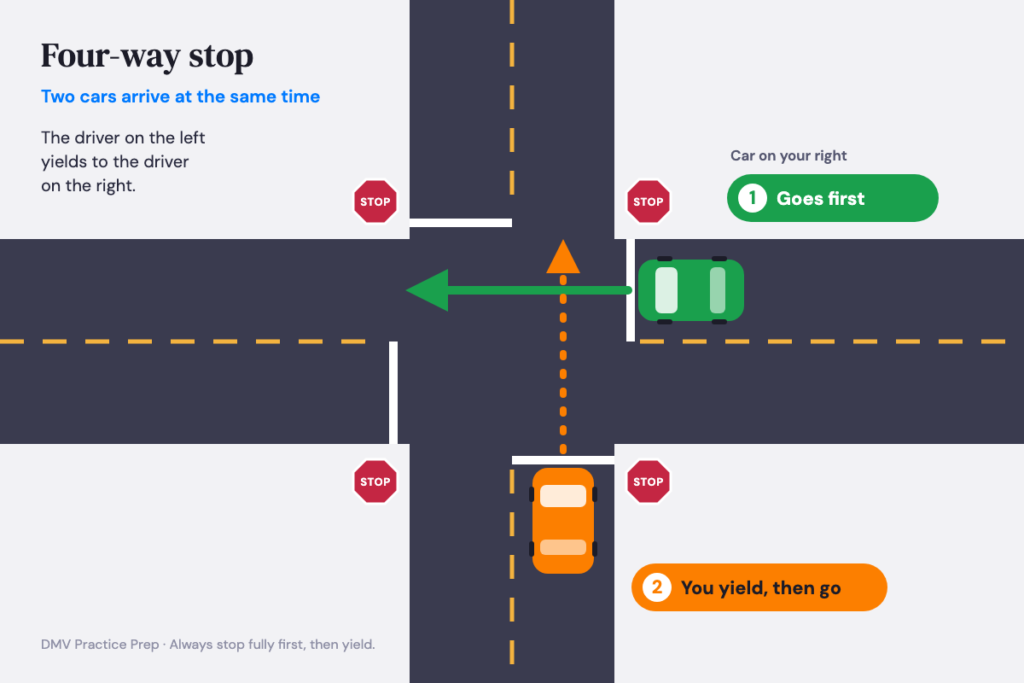
For example, imagine another car reaches the stop on your right at the same moment you do. Wait for it to go when the intersection is clear. Do not use a wave or a quick roll forward as a substitute for checking traffic. A drawing can help you learn the pattern, but the real decision also includes what everyone is actually doing.
What happens at an uncontrolled intersection or a driveway?
The handbook’s right-of-way chapter explains the rules for intersections without controls, different road configurations, and entry from private roads. In the ordinary uncontrolled-intersection situation, yield to a vehicle on your right when the applicable rule requires it. Do not use that shortcut to ignore an existing sign, through road, or vehicle already in the intersection.
When entering a road from a driveway, private road, alley, or building, stop before the sidewalk and yield to approaching vehicles and pedestrians. At a T-intersection, traffic from the ending street must stop and yield to the through street. Identify the road layout first; “I arrived first” is not a universal answer for every kind of intersection.
| Situation | What to check |
|---|---|
| All-way stop | Arrival order; yield right for simultaneous arrivals |
| Ending road at a T-intersection | Stop and yield to the through road |
| Private driveway or alley entry | Stop before sidewalk and yield to approaching traffic and pedestrians |
| Left turn across opposing traffic | Yield to traffic coming straight through and watch pedestrians |
| Roundabout entry | Yield to circulating traffic that conflicts with your entry |
Use our Texas road signs guide to distinguish signs that change the intersection’s control. Before a practice answer, name the setting: controlled intersection, uncontrolled intersection, ending road, or private entry. That keeps one remembered rule from being applied to the wrong situation.
Who yields during a left turn or freeway entry?
A driver turning left must yield to oncoming traffic proceeding straight through, as the Texas handbook explains. Wait until you can see the lanes you must cross and the path is clear. Do not assume an approaching vehicle’s signal guarantees where it will go.
Entering freeway traffic also requires yielding to vehicles already on the freeway. Choose an opening that leaves enough space rather than forcing others to brake. Try this app question before opening the answer, and picture which vehicle is joining an established traffic stream.
A driver entering interstate traffic from an entrance or acceleration ramp:
- A. Should yield to drivers already on the interstate.
- B. Has the right-of-way.
- C. May force their way into traffic.
- D. Can assume that other drivers will change lanes to make room.
Show answer
A. Should yield to drivers already on the interstate. Entering drivers wait for a safe gap in the established traffic stream. Signaling does not require freeway traffic to yield the lane to you.
A signal communicates your intention; it does not give you ownership of the gap. If the available space changes, keep observing and make a safe decision. These rules matter in driving practice as well as knowledge questions. Our Texas road test checklist connects observation and positioning with the skills the examiner watches.
When should drivers yield to pedestrians?
Watch for people in and approaching crossing areas, and follow the applicable signs and signals. TxDOT’s school-zone guidance tells drivers to stop and yield to people in crosswalks and obey crossing guards. Never treat priority as permission to move into a person’s path.
When turning, look beyond approaching vehicles to the sidewalk and the road you will enter. A pedestrian may be outside your initial forward view. If another vehicle blocks your view of a crossing, slow and assess before continuing. The safe question is whether the path is clear, not whether you can defend arriving first.
What do you do when an emergency vehicle approaches?
The Texas Driver Handbook explains yielding to an approaching emergency vehicle using its warning equipment. Move toward the right edge and stop as required, clear of an intersection, while avoiding an abrupt move into someone else’s path. Check what is beside and behind you before repositioning.
Do not confuse an approaching emergency vehicle with one stopped at the roadside. Stopped emergency and certain service vehicles trigger separate move-over or slow-down duties. Study the distinct situations so you do not pick a response meant for a moving siren when the question describes a stationary vehicle.
Who has priority at a roundabout?
Vehicles entering must yield to those already circulating. TxDOT’s roundabout guidance explains the entry decision: wait for a safe gap before joining the circle. Choose the correct lane in advance, follow signs and markings, and avoid a sudden lane change to rescue a missed exit.
In practice review, draw the circulating vehicle’s path before drawing the entering car. That makes the conflict easier to see. For broader exam preparation, use our Texas written test guide and explain the rule behind each right-of-way answer.
Key takeaways
- Identify signs, signals, road layout, and existing traffic before choosing a rule.
- Yield right for simultaneous arrivals at an all-way stop.
- Yield when entering an established traffic stream or turning across its path.
- Priority never replaces checking that the space is safe.
Practice Texas car right-of-way decisions. Start a free practice test and review why each driver should wait or proceed.
Continue in the Texas car hub.
Related guides

Texas Road Signs Test: Signs You Must Know
Prepare for Texas road sign questions by learning regulatory, warning, and guide signs, then connecting each sign to the right driving action.

Common Texas Road Test Mistakes (and How to Avoid Them)
Use ten Texas road test practice checks to improve observation, stops, speed, lane position, signaling, and appointment preparation.

Texas DUI Laws & BAC Limits
Texas prohibits any detectable alcohol for drivers under 21. Adults can violate impairment laws below 0.08%; review DWI and ALR basics.


